
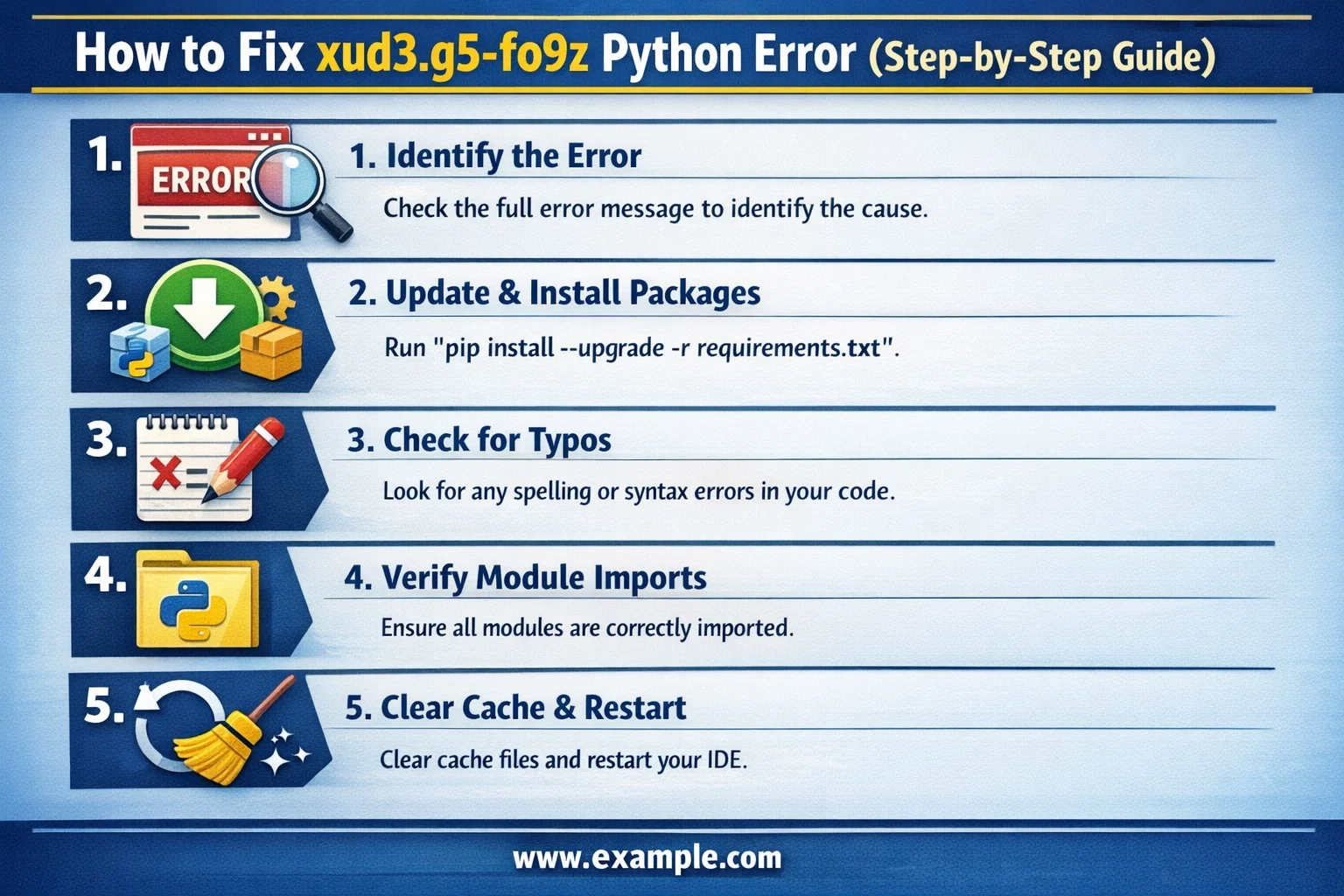
Introduction to How to Fix xud3.g5-fo9z Python Error
Seeing an error message pop up on your screen can be frustrating. If you are working on a Python project and suddenly see the xud3.g5-fo9z python error, you are not alone.
This error often appears when Python cannot find a specific module or file. It stops your code from running. For many developers, especially beginners, this message looks confusing. It might seem like a complex system failure, but in most cases, it is simply a sign of a small misconfiguration in your setup.
In this guide, we will explain what this error means. We will walk you through a simple, step-by-step process to fix it. By the end of this article, you will understand how to solve the xud3.g5-fo9z python issue and get your code running smoothly again.
Table of Contents
What is the xud3.g5-fo9z Python Error
The xud3.g5-fo9z python error is typically an import error or a module not found error. When Python executes a script, it looks for specific files and libraries. If it cannot locate a required piece of code, it raises this error.
This name (xud3.g5-fo9z) often represents a placeholder or a specific file name that your project is trying to access. It could be a custom module you created, a misnamed file, or a dependency that failed to install correctly.
In simple terms, Python is telling you: “I looked for this specific component, but I cannot find it.” The error usually appears in your terminal or console window, stopping the execution of your program until it is resolved.
Why the xud3.g5-fo9z Python Error Happens
Understanding why this error happens helps you prevent it in the future. Python relies on a specific path to find modules. If that path is broken, the error appears.
The main reason is that Python’s interpreter cannot locate the file or module named xud3.g5-fo9z. This might be because the file was deleted, moved, or never created. It could also be that your virtual environment is not activated, so Python is looking in the wrong folder.
Another common reason is version mismatches. If you installed a package using a different version of Python than the one you are running, the system will not see the package, resulting in the xud3.g5-fo9z python problem.
Common Causes of xud3.g5-fo9z Python Error
To fix the error, you must first identify the root cause. Here are the most common reasons why this error happens:
- Wrong Python version: You are using Python 3.11, but the package was installed for Python 3.9.
- Broken virtual environment: The virtual environment is corrupted or not activated.
- Dependency conflicts: Two packages require different versions of the same library.
- Incorrect import statements: The code has a typo or the file name does not match the import.
- Corrupted Python installation: The Python interpreter itself has missing files.
Step-by-Step Guide to Fix xud3.g5-fo9z Python Error
Now, let us fix the error. Follow these steps in order. They are designed to solve the xud3.g5-fo9z python error quickly.
Step 1 – Check Python Version
First, you need to confirm you are using the right Python version. Open your terminal or command prompt. Type the following command:
python --versionIf you have multiple versions installed, you might also try:
python3 --versionCheck your project’s documentation. It should list the required Python version. If your version is too old or too new, you will need to update Python or create a new environment with the correct version.
Step 2 – Activate Virtual Environment
Virtual environments keep project dependencies separate. If you are not inside the correct environment, Python will not see the installed packages.
To activate the virtual environment:
- On Windows:
bash .\venv\Scripts\activate - On Mac/Linux:
bash source venv/bin/activate
Once activated, you will see the environment name in your terminal prompt. If you do not have a virtual environment, create one using:
python -m venv venvStep 3 – Reinstall Dependencies
Sometimes, a package installation fails midway. Reinstalling dependencies can fix this. First, make sure you are in the correct directory where your requirements.txt file is located.
Run the following command to install all required packages:
pip install -r requirements.txtIf the error persists, try upgrading pip first:
pip install --upgrade pipThen, reinstall the specific package that might be related to xud3.g5-fo9z.
Step 4 – Check Import Statements
A simple typo can cause the xud3.g5-fo9z python problem. Look at your Python code. Find the line where the import occurs.
It might look like this:
import xud3.g5-fo9zCheck if the file name matches exactly. File names are case-sensitive on many systems. If the file is located in a subfolder, ensure the folder structure is correct. If you are importing a local file, make sure the file exists in the same directory.
Step 5 – Test Python Installation
If the above steps did not work, your Python installation might be corrupted. You can test this by running a simple command.
Open your terminal and type:
python -c "print('Hello World')"If this does not work, Python is not set up correctly. In that case, you should uninstall Python and download the latest version from the official Python website.
Quick Troubleshooting Table
If you are in a hurry, use this table to find a quick fix for the xud3.g5-fo9z python error.
| Problem | Possible Solution |
|---|---|
| Wrong Python version | Install the correct version using pyenv or the official installer. |
| Broken virtual environment | Delete the venv folder and run python -m venv venv again. |
| Dependency conflicts | Run pip freeze to see installed packages, then reinstall them. |
| Incorrect import statements | Double-check the spelling and file path in your code. |
| Corrupted Python installation | Reinstall Python from the official website. |
Best Practices to Prevent xud3.g5-fo9z Python Error
Prevention is better than cure. Here are some best practices to avoid facing this error in the future.
- Always use virtual environments: This isolates your project dependencies and prevents conflicts between different projects.
- Freeze your requirements: After installing packages, run
pip freeze > requirements.txtto save the exact versions. This ensures consistency. - Use consistent naming: Avoid using special characters like hyphens (
-) in file names or module names if possible. Python handles them differently. - Keep Python updated: Use the latest stable version of Python to benefit from bug fixes and security updates.
- Run tests regularly: If you have a large codebase, write small tests to ensure your imports work after changes.
Frequently Asked Questions (FAQ)
Here are the answers to common questions regarding this error.
What is xud3.g5-fo9z python error?
It is an error that occurs when Python cannot find a specific module or file required by your script. It usually appears as “ModuleNotFoundError” or “ImportError”.
Is xud3.g5-fo9z a real Python module?
No, xud3.g5-fo9z is typically a placeholder name. In real projects, it represents the actual file name or module that Python is failing to locate.
How can I prevent Python environment errors?
Always activate your virtual environment before installing packages or running code. Use a requirements.txt file to manage dependencies.
Why does Python show unknown module errors?
Python shows this error when the interpreter cannot find the module in its search path. This happens if the module is not installed, the environment is wrong, or there is a typo in the import statement.
How do I fix Python dependency issues?
You can fix dependency issues by creating a fresh virtual environment and reinstalling all packages using pip install -r requirements.txt. Use pip check to see if there are any conflicts.
Conclusion
The xud3.g5-fo9z python error can be scary at first, but it is usually easy to fix. In most cases, the solution is checking your Python version, activating your virtual environment, or reinstalling your dependencies.
Remember to follow the steps in order. Start by verifying your environment, then move to your code imports, and finally check the Python installation itself. By following the best practices outlined above, you can avoid this error in your future projects.
Take a moment to review your setup today. A clean environment leads to smooth coding.
